published: 04-05-2026
updated: 07-05-2026
The Capetown Blackheath plant & the numbers
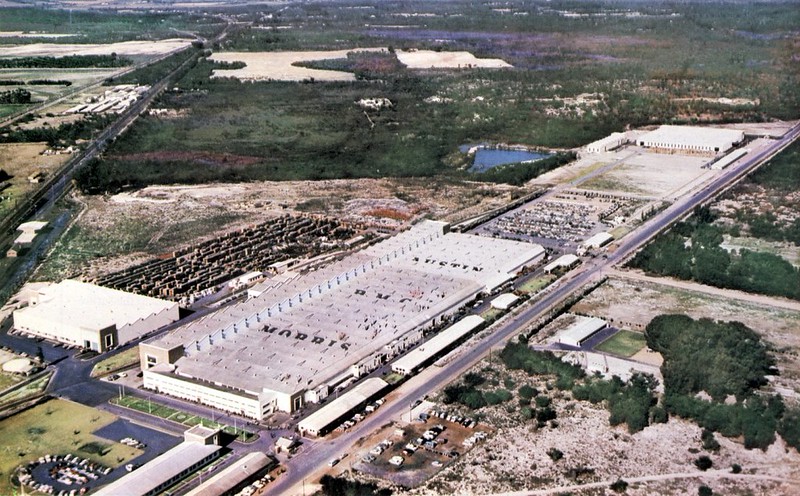
South Africa produced approximately 104,772 Minis between 1959 and 1983, making it one of the largest non-UK production centres in Mini history. For context, the entire UK run across four decades was roughly 5.38 million, so South Africa was a rounding error in global terms, but a substantial local industry in its own right.
The annual breakdown tells the story of the model's rise and gradual decline: the high mark was around 8000 units per year in '63 and 64, in '77 that number had dwindled to less than half. A full list with production numbers can be found at the end of this aticle. Production briefly ceased in October 1978 due to an abortive merger between Leyland South Africa and the Sigma Motor Corporation. When that deal collapsed, production restarted in May 1980 and ran until October 1983, making South Africa the last country outside Britain to build the classic Mini (Moke production aside). Commercial variants, vans and pick-ups, added another approximately 11,469 units between 1961 and 1979.
By the end, the numbers are modest, the results impressive.
Everything ran through Blackheath, on the outskirts of Cape Town. The plant wasn't just an assembly point, by the mid-1960s it was a genuine manufacturing facility. This distinction matters, because it explains almost everything that makes South African Minis different.
The South African government, like Australia and several other countries, used local content regulations as a trade instrument. Manufacturers who hit prescribed local content thresholds earned import excise rebates and tariff protection. Miss the targets and your business case falls apart. So Leyland South Africa had every incentive to manufacture locally rather than just bolt together imported kits.
South Africa's local content rules were unusual in being measured by weight rather than by production cost (as in Australia). This created some interesting engineering choices. By 1964, the local content requirement was 45% by weight, reached through a programme rolled out in three phases:
Phase I covered hang-on parts from day one: brake drums, battery, road wheels, interior trim, boot lid hinges, bonnet hinges, bumper over-riders, and a long list of smaller brackets and fittings.
Phase II went deeper, requiring functional mechanical components. BMC South Africa began machining and assembling 848cc and 1098cc engines locally in February 1964, with rough-cast blocks imported from the UK and machined at Blackheath. By 1 July 1964, Minis were officially declared "manufactured" in South Africa rather than merely assembled.
Phase III By 1967 local content had reached 58.8%, rising to 66% by weight by 1975. At that point the South African Mini had more South African in it than British. Which is exactly the point where things start diverging in fascinating ways.
The Blackheath plant also assembled Land Rovers, Jaguars, Triumphs, and the Morris Minor, a genuinely diverse operation that gave the engineering team real capability. That capability would matter enormously when the 1275GTS came along.
Buying a South African Mini expecting a UK car with right-hand drive is like ordering a Johnnie Walker and being handed a Jack Daniels. Same idea, noticeably different.
Battling the climate
South Africa is hot and dusty and thus has no use for a heater most of the year. Heaters were an option which most buyers didn't bother with. The associated ducting, matrix, and controls were simply absent. This has two practical consequences for modern restorers: finding an unmolested South African Mini in Europe with a correct original interior means there's a box behind the dashboard that simply isn't there. Fitting an European one requires a different thermostat housing, making or enlarging holes in the bulkhead and fitting a cable and kno to the dashboard. When you are not going for orignality, fitting an electrical heater is a good and easier option.
The tropical cooling fan was standard, more blades, more airflow. The radiator overflow system was adapted for the harsher thermal environment. Air filter housings were larger than UK spec to handle the dust. Most likely this was done from 1968 onwards, with the introduction of the Mk2 and Leyland badging on the one hand and the increased localisation on the other. Earlier models had the auxilaries we European fols are familiar with.
Windows
From 1967, South African Minis adopted roll-up windows with opening quarter-lights, the vent-wing style familiar from the Australian cars and from the later ADO16 range. This was a significant departure from the sliding windows of UK-spec cars. The result is a South African Mini interior that feels markedly more modern and practical than its British equivalent. Wind-down glass, a sensible hinged quarter-light for ventilation, things we European buyers wouldn't get until later in the model's life. We wouldn't get the quarterlights at all unless you had a Wood & Picket or a Radford, who needed them to install their electric windows. Although visually similar, the window assemblies are not interchangeable with the Australian equivalent.
Engines
As noted above, engine blocks were cast locally from the mid-1960s, up until then standard A-series engines where used. The South African units had integral side covers and an internal oil filter gallery, which placed the oil filter high on the block above the starter motor. On a UK Mini, the filter is low on the front right near the sump. On a South African car, it sits up high, accessible, and very clearly not standard issue. This is one of the most reliable identification points for anyone examining an engine bay. Later cars had Leyland SA stamped on the block.
The bore was 70.64mm with a stroke of 81.33mm for the 1275cc unit, identical to the Cooper S specification. The 1098cc was achieved with a shorter-stroke crank (69.85mm stroke), using significant parts interchangeability with the 1275, whereas the original 1098cc is a long stroked 998., This commonality was deliberate: the same 1275cc block powered the local ADO16 1300 and the South African Marina, so rationalising around it made economic sense. The British 1098 however was a short-stroked 1275.
The South African 1098cc engine is highly prized by tuners because it uses the "Large Bore" 1275 block architecture but with a shorter stroke (69.85mm), making it very similar in geometry to the legendary 1071cc Cooper S (70.6mm bore x 68.26mm stroke).
Body and Trim
Early South African cars are close to UK spec. As local content requirements tightened through the late 1960s and 1970s, the differences compound. Locally manufactured panels, locally sourced trim materials, different electrical components. By the 1970s a South African Mini and a UK Mini are clearly cousins rather than twins. Interior fabric which was often brown, rather than black, switches, badging, all locally sourced, all slightly different. The dashboard evolved separately. An original restoration of a South African car requires South African parts in some cases, not UK parts. They kept the external doorhinges longer than their UK countrparts.
Colours
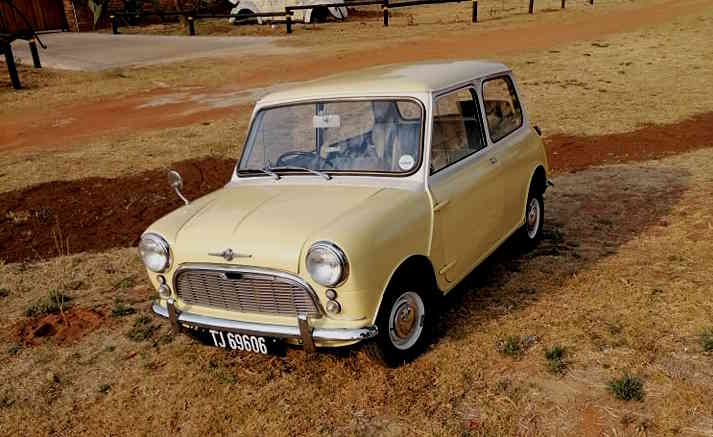
As sunny South Africa is quite different from dreary grey England this also reflects in the colours. The brighter Killarney Blue (named after the raceway near Johannesburg), Aloe Red, and Protea White were exclusive to the country. Contrasting roofs were more common and quite a few cars were delivered to dealers just in primer to receive their final colour. One practice was to have the A-, B- and C-pillars in a dfferent colour. So in the paperwork you might find colours that are untraceble.
The Mini as a policecar
In the mid-1970s, the South African Police used Mini 1000s as pursuit vehicles on township roads, not because they were fast, but because nothing else could follow a fleeing suspect down the narrow alleys between the houses in the toownships. A Land Rover couldn't fit. A Ford Cortina couldn't turn. The Mini could do both, and it could do them at the same time.
The irony was not lost on anyone. The same car that symbolised classless, cheerful, swinging-sixties egalitarianism in Europe, the car driven by The Beatles, by Twiggy, by every aspirational young Briton who wanted to look modern without looking rich, was being used by the apartheid state as a tool of control in the townships it was busy enforcing. Alec Issigonis designed a car for everyone. South Africa found a use for it that he almost certainly never imagined.
The Mokes went to the Air Force, the bakkies went to the farms and the saloons went to the townships. One car, three South Africas.
The oddities: Riley, Wolseley, and the MK3
The Wolseley 1000
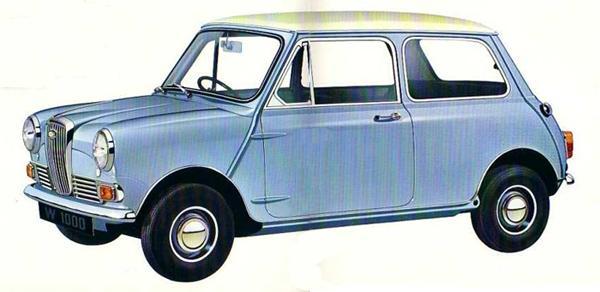
In 1967, Leyland South Africa produced the Wolseley 1000, but not how we know it. Somewhere some drawings did go lost or it was put together on a Monday morning? The elaborate Wolseley Hornet front end (complete with the obligatory illuminated grille badge) was mounted on a standard Mini shell, completely forgetting the extended boot of the Wolseley. In the end that came right but not in a way you would expect. More interior luxury and sell it as an upmarket proposition. The doors were fitted with the Australian-influenced roll-up windows and opening quarter-lights, giving the Wolseley 1000 the unusual combination of a chrome-festooned face and a more practical interior than its UK Hornet equivalent. At least that was the tinking behind it.
Inside, the dashboard featured additional padding and a centrally-mounted three-dial instrument pod: speedometer flanked by water temperature and oil pressure gauges, with a cluster of warning lights. The engine was the 998cc A-Series and for comfort the Hydrolastic suspensionwas fitted.
The Wolseley 1000 ran for two years, 1967 and 1968, before being replaced by its structural opposite...
...The Mini MK3
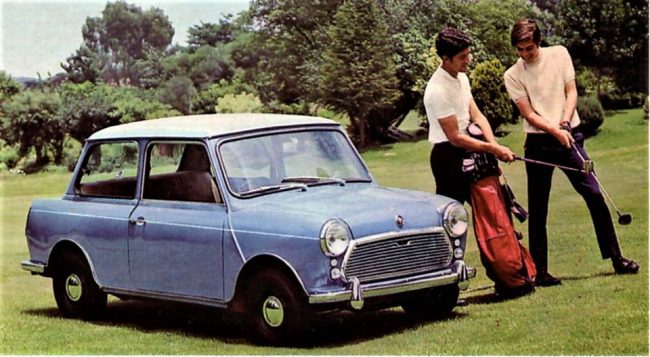
Not to be confused with anything in the standard UK production history, the South African Mini MK3 (pay attention to the capital K) is a car that shouldn't exist but does, and it looks exactly as akward as you would expect.
When Riley Elf and Wolseley Hornet production ended in the UK in mid-1969, the tooling for their distinctive extended boot and longer rear wings was earmarked to be shipped to South Africa. The intention was to offer South Africans a Mini with approximately 50% more boot capacity than the standard car, a genuine practical improvement for a market where the Mini competed against roomier alternatives.
The resulting car, launched in September 1969, combined the standard rounded Mini front end with the Elf/Hornet extended boot rear. Classic Mini front. Three-box Elf back. Where the Wolseley 1000 had grafted a posh face onto a regular Mini body, the MK3 took the opposite approach: a regular Mini face on an extended Mini backside. The name "MK3" was confusing enough that it caused arguments for decades, and the car looked, there's no charitable way to put this, like a Mini that had reversed into another Mini. But it had a bigger boot, and South African buyers appreciated that.
The MK3 replaced the Wolseley 1000 in the lineup and was positioned as the roomier, more practical offering alongside the standard Mini. Production ran from 1969 to 1971, when it was replaced by the Clubman saloon.
There is a footnote. Board meeting minutes held at Gaydon show that in March 1970, nearly a year after UK production of the Elf and Hornet had ended, the rear body panels for the "Mini Elf" were still being pressed in Britain and exported to South Africa for the MK3. The tooling transfer had either not happened or had happened only partially. When the MK3 was cancelled in 1971, the extended rear end disappeared from South African production permanently, later Clubman-nosed cars never got it, although that was a serious prosal, and the round-nosed cars of the 1970s used the standard Mini boot. A Mini MK3 in original condition today is a genuinely rare car, and one of the more visually arresting objects in the classic Mini universe.
<
The Round-Nose Specials, 1977–1978
The round-nose special editions were launched in quick succession: Sunshine in February 1977, Moonlight in September 1977, Mini Deluxe Special in June 1978, and Mini Vanden Plas in August 1978. These were all based on the classic rounded-nose body.
The Sunshine and the Moonlight launched in 1977. The first offered in a bright two-tone colour scheme (yellow featured prominently), with special trim and decals to differentiate it from the base Deluxe. The Moonlight followed a few months later Sunshine. The Moonlight is the the more common one; it leaned into a cooler, darker colour palette (silver/grey tones were characteristic) with matching interior detailing. It became something of a cult car in SA circles, partly because documentation on it is scarce.
The Vanden Plas — launched August 1978, this was the upmarket end of the round-nose special run. Still on the classic body, but with luxury-oriented interior trim, walnut-effect or wood-grain dashboard elements, better seat trim, and upscale badging borrowing the Vanden Plas name.
The Model Range at a Glance
With a few exceptions, the model range ran pretty much parrallel to th UK. The end dates tend to differ.
- Mini 850 / Mini 1000, the standard round-nose car, in continuous production from 1960 to 1980
- Austin and Morris Cooper / Cooper S, assembled from CKD from 1961, with local engine manufacturing from 1964
- Wolseley 1000, 1967–1969, the posh-front standard-body car
- Mini MK3, 1969–1971, the strange one
- Mini Clubman Saloon and Estate, from August 1971, replacing the MK3
- Mini 1275 GTS, from July 1973 (more on this below)
- Mini Moke, in production beyond the saloon's end in 1983
- Mini 1275E, the final model, launched 1980, running to the end in 1983
The 1275GTS: for the little old ladies it is not
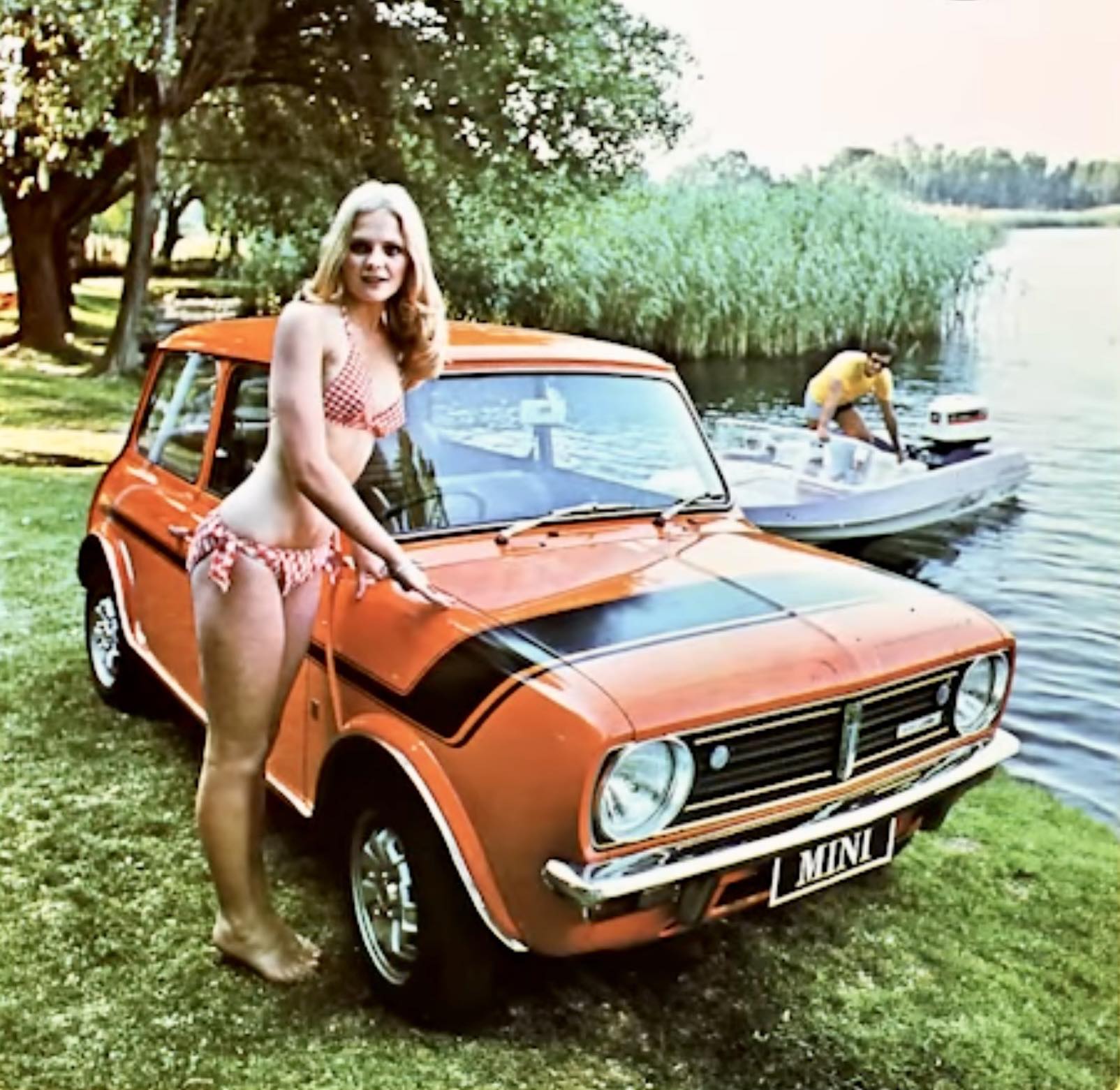
This is the one that matters most and the rest of the world has never heard of.
When British Leyland terminated its relationship with John Cooper in 1969, his name disappeared from the range. In the UK, the replacement was the 1275 GT, a Clubman-nosed car with a single-carburettor. The 1275cc engine producing 59 bhp. It was decent, but it was not a Cooper S.
At Blackheath, the engineering team led by Ralph Clark had been modifying Cooper S engines for South African racing for five years. They were not going to settle for 59 bhp.
Being a wholly-owned but separately listed subsidiary of British Leyland gave Leyland South Africa a degree of operational liberty that the UK operation did regret. They could do things Longbridge wouldn't have approved off and so they did.
The Engine
The starting point was the Cooper S block specification: 70.64mm bore, 81.33mm stroke, 1275cc. The South African engineers then went further. They increased the bore and shortened the stroke, producing a higher-revving, more free-breathing unit. Then they highly polished the combustion chamber, cross-drilled the crankshaft, fitted aluminium pistons and new steel-alloy valves. Twin SU 1¼-inch carburettors were fitted, with a matching ported and polished cylinder head. A free-flow exhaust manifold completed the picture. An electric fuel pump replaced the mechanical unit. The result was 74 bhp, against the UK 1275GT's 59 bhp. The GTS was quicker to 100 km/h than the Cooper S it replaced.
The Chassis
The two small fuel tanks that sat under the standard Cooper's boot floor were replaced by a single 35-litre tank. At the front, 8¼-inch disc brakes, larger than UK spec, were paired with 12-inch wheels instead of the standard 10-inch. The vacuum-assisted master cylinder disappeared because with brakes this size you didn't need it, replaced by a proper dual-circuit braking system. Wide-arch body extensions accommodated the 12-inch wheel setup.
The SA Custom slot mag wheels that replaced the initial Rostyles became closely associated with the car, also known as the Leyland Cooper, and are now collectible in their own right. Tinted glass, twin exterior mirrors front and rear and a distintive stripe across the sides and bonnet completed the look.
The Interior
The GTS introduced several interior firsts for the Mini. It had a tachometer, the first time in Mini production history that the standard car came with a rev counter. There was a leather-clad steering wheel. The key moved from the centre console to a key-locking steering column. A new dashboard design incorporated a small glove compartment. New bucket seats with headrests were fitted, though someone at Blackheath apparently forgot that forward-tilting front seats are rather important when you need to access the back, and the new seats didn't tilt. A minor oversight on an otherwise well-resolved car.
Launch and Legacy
The 1275 GTS was launched on 26 July 1973, marketed under the Leykor brand (Leyland's politically cautious South African trading name, constructed from "Leyland" and "Korpporatse," the Afrikaans word for Corporation, a careful linguistic distance from a parent company that preferred not to be associated with apartheid while still very much doing business there).
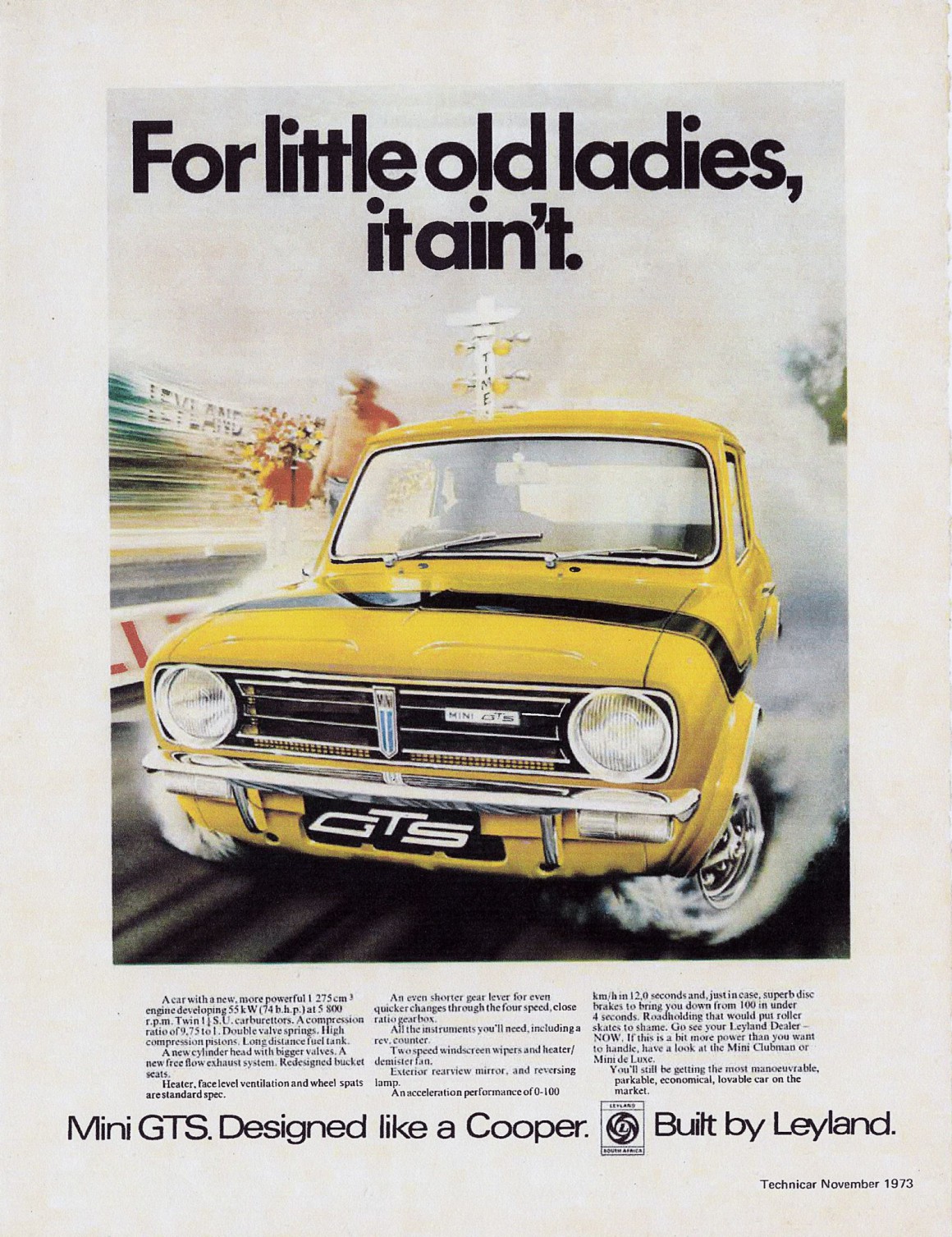
The advertising was direct and memorable: "For little old ladies, it ain't" and "Designed like a Cooper. Built by Leyland."
It delivered on both counts. The GTS dominated the Asseng Group 1 and Castrol Marketcars Standard Production Championships at world-class circuits, Kyalami in Johannesburg and Killarney in Cape Town. Both circuits had hosted Formula 1. Both had lost their international sanction due to the apartheid boycott. The GTS won on them regardless, and nobody outside South Africa heard about it.
Total production is estimated at approximately 4,212 cars before production ended in March 1980. Fewer than 100 were finished in silver metallic paint, which was a costly option. They are genuinely scarce.
The 1275E: the final goodbye
When South African Mini production restarted after the failed Sigma merger in 1980, it came back with one final model: the 1275E. Clubman-nosed, with a 56 bhp version of the 1275cc A-Series, 10-inch steel wheels and drum brakes all round. A sensible, economical car to close out the production run, no arches, no tachometer, no slot mags. Production ran to October 1983, with sales continuing into 1984. The Mini's last stand in South Africa was quiet, as last stands usually are. There where the HLE and LTE with different trimlevels and two binacles. As supposedly only 46 of the HLE were built, this is a very sought after car. And then as the final closure, there was the Rebel. Only available in red with Rostyle wheels and rear window louvres, sunroof and rev counter, this was the most expensive Mini to come come out of Blackheath.
The Working Minis: Vans, Pick-ups, and the Estate Question
The sporting Mini’s get the glory and live on, their working mates just manage to scrape a by line in history, which is a pity, because they represent the largest single continuous production thread in the entire South African Mini story.
The Van
The Mini Van arrived in South Africa essentially alongside the saloon, and it outlasted almost everything else in the range. In the UK, the van ran from 1960 to 1983, the same full span as the Mini itself, making it the longest-lived commercial variant. South Africa followed suit, assembling the van at Blackheath from the early 1960s onwards, and continuing production well after the pick-up's discontinuation.
The South African van was mechanically consistent with the saloon of its era, inheriting the same engine transitions, 848cc initially, switching to the locally manufactured 998cc unit around 1969. The body was the same steel-panelled, no-side-windows load carrier as the UK version: a full-length cargo area where the rear seat would have been, accessed via twin rear doors. No frills, no pretence. It was a van.
What makes the South African van particularly interesting today is simple survival arithmetic. A van lives a working life. It gets used, loaded, driven hard, and when it wears out it gets replaced rather than restored. The attrition rate on working Minis, anywhere in the world, is brutal. A South African van that made it to the present day without having been ground into the earth by a decade of trade use is a rare thing. But those that did survive did so in the conditions that favour bodywork preservation: no salt, low humidity, a dry climate that doesn't eat steel. When a South African van does surface, it tends to be in better structural condition than its UK equivalent simply because the environment was kinder to metal that wasn't being actively destroyed by winter roads.
The van's rear light cluster changed during production, the earlier stepped-type units (shared with the pick-up) were replaced with a different design when the van continued into the late 1970s and beyond. This is worth knowing when sourcing correct parts for a restoration, because the two types are not interchangeable and the wrong lenses are the sort of thing that looks fine in photographs and wrong in person.
The Pick-up, The Bakkie, the quarter-tonne
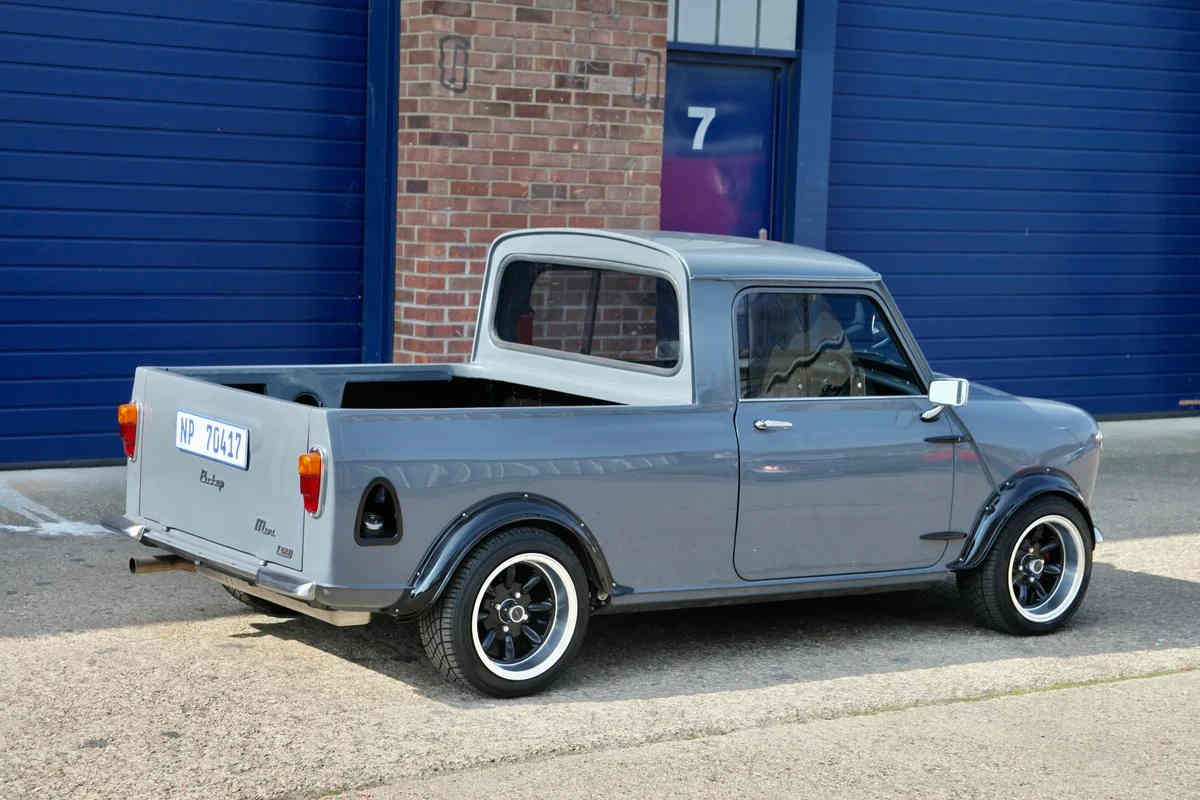
South Africa is bakkie country. Not by preference; it is a geological and agricultural fact. The country runs on light pick-ups in a way that European markets simply don't, and the Mini pick-up, the Mini bakkie, was the car that brought that culture to its most improbable logical conclusion.
The Mini pick-up in South Africa ran from 1961 to approximately 1971, with the locally manufactured 998cc engine replacing the original 848cc unit around 1969 when the South African-built A-Series came online. Estimated total South African production is in the region of 2,500 units, a small number that reflects the pick-up's niche within a niche, but enough to establish it as a genuine production model rather than a curiosity.
The body was similar with the UK Mini pick-up: the standard Mini front end and cab, the floor extended rearward into a flat cargo bed, and a tailgate. The wheelbase was unchanged from the saloon, which meant the load bed was, to put it diplomatically, compact. You were not moving house with a Mini Bakkie. You were moving things that fit in a bakkie, and you made peace with that distinction. What you got in return was the Mini's characteristic agility and, in a country where roads outside the major cities could be variable in the extreme, its light weight and mechanical simplicity. To deal with the gravel roads the rear suspension was reinforced, also they often had locally made canopies (caps).
The rear light clusters on the South African pick-up followed the same stepped-type design as the van. Sourcing correct replacement lenses has historically been difficult, the stepped units were shared with several other British cars of the era, including the Rover P4 and the Alvis, which tells you something about the procurement logic at play.
The pick-up ended production around 1971, coinciding with the Clubman's introduction and the broader rationalisation of the range. The van continued. The bakkie did not get a Clubman-nosed replacement, and there was no GTS pick-up. The bakkie's era was the round-nose era, and when that era ended, it ended with it.
Today, a South African Mini pick-up in usable original condition is a genuinely rare vehicle. They worked for a living, and working vehicles mostly don't make it. The ones that do tend to surface at exactly the sort of barn-find moment this industry runs on.
The most common explanation for Bakkie is that it refers to the loading space being in the back. However in Dutch that word in slang is also used for a small trailer, literally meaning container. As Afrikaans is a derivative of 17th century Dutch there might be an explanation there.
The Countryman and Traveller: An absence worth noting
Here is where the South African story takes a slightly unexpected turn: the Countryman and Traveller, the estate variants that were available in the UK from 1960, and that sold approximately 108,000 and 99,000 units respectively before being replaced by the Clubman Estate in 1969, had a very limited presence in South Africa.
Wikipedia confirms that estate variants were built in South Africa, alongside Innocenti in Italy and a Portuguese assembler. The Clubman Estate was briefly offered in South Africa after 1971. But the woodie, the ash-framed Countryman/Traveller with its shooting-brake aesthetic that became one of the most recognisable Mini variants in Europe, was not a South African staple. The market didn't really ask for it. South Africa already had the pick-up for load carrying, the Moke for open-air utility, and the standard saloon was compact enough for most purposes. The estate's particular combination of increased luggage capacity and decorative timber framing was solving a problem the market didn't feel it had.
This means that if you encounter a South African estate, particularly an early Countryman or Traveller, it is worth treating with some suspicion. They were not common new, and they were not common in subsequent decades. What gets described as a South African Countryman is sometimes a UK car with South African registration history rather than a car assembled at Blackheath. The VIN prefix and body plate are the things to check. A genuine Blackheath estate is an unusual car.
The Clubman Estate is a different matter, it appeared in South Africa briefly after the Clubman saloon's 1971 launch and was assembled at Blackheath. It's more plausible as a genuine locally-assembled car, but equally uncommon.
The Mini Moke: Africa's Own Chapter
The Moke deserves its own section in any African Mini story, because its African production history is both longer and stranger than most people realise, and because it ran on after the saloon had stopped, making it the actual final act of Mini manufacturing on the continent.
South Africa
Moke assembly at Blackheath began around 1963, essentially concurrent with the first British-built Mokes coming off the Cowley line. The first six South African Mokes were reportedly hand-fabricated using brake presses, not assembled from panels but beaten into shape by the Blackheath team before the CKD kits started arriving from Britain. The first South African Mokes were literally hand-made. Imagine getting your hands on one of those.
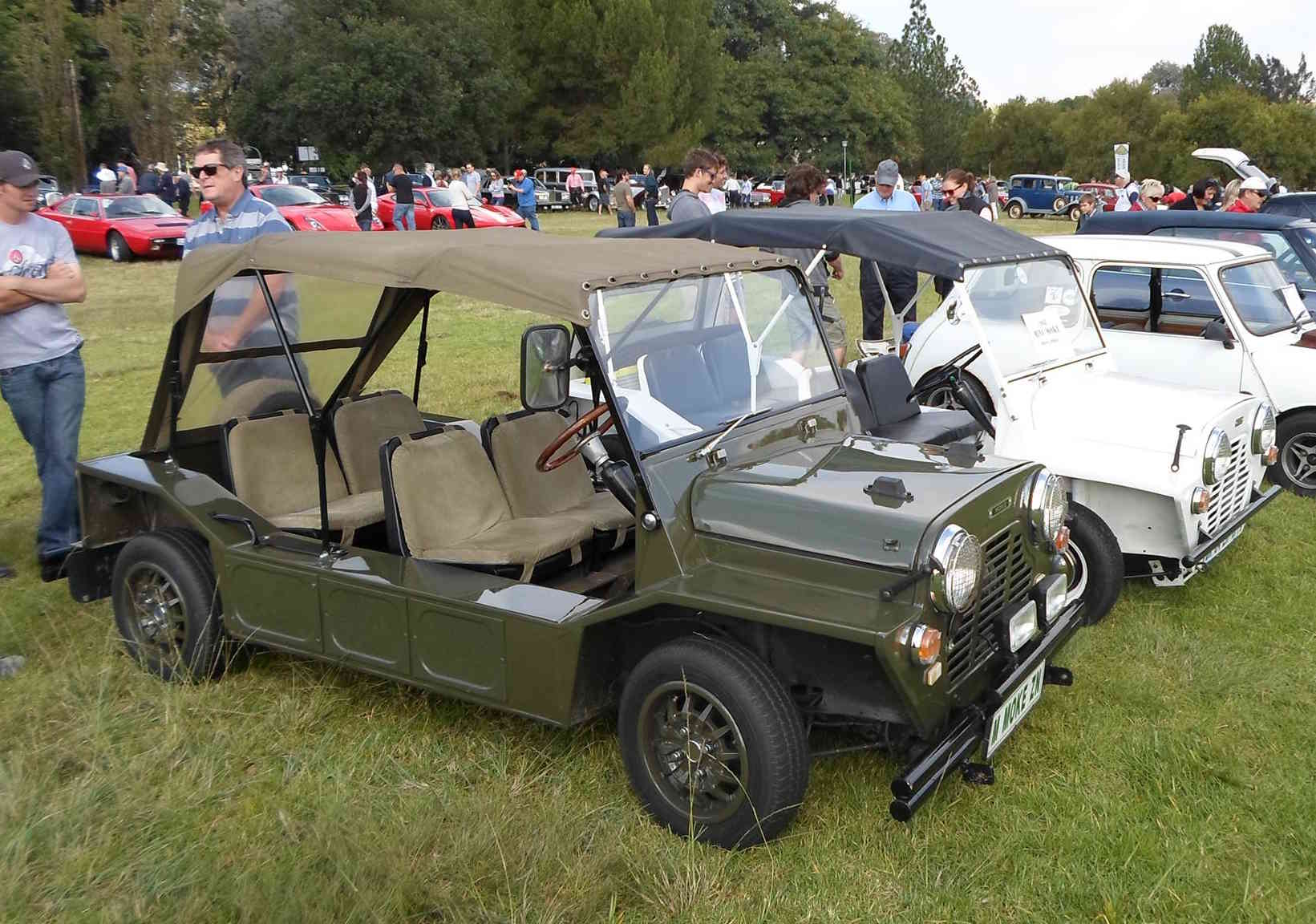 After that initial handful, production shifted to the CKD model: panels arrived from Britain, while subframes, glass, tyres, trailing arms, and wiring were sourced locally. The engine used throughout the South African Moke run was a modified 1098cc A-Series with a shorter stroke, reducing capacity to 998cc, consistent with the local content engineering approach applied to the saloon range and driven by the same cost and parts-rationalisation logic. Unlike the Australian Moke, which moved to 13-inch wheels in 1968 for better ground clearance, the South African Moke stayed on 10-inch wheels throughout its production run. The official reason was the added cost of tooling up and uncertainty about durability effects on the transmission.
South African Moke production ran from 1963 to 1969 in the first phase, with a total of 412 units built across those years:
| Year | Units |
|---|---|
| 1962/63 | 6 |
| 1963/64 | 9 |
| 1964/65 | 78 |
| 1962/63 | 6 |
| 1963/64 | 9 |
| 1964/65 | 78 |
| 1965/66 | 147 |
| 1966/67 | 96 |
| 1967/68 | 37 |
| 1968/69 | 39 |
The model years here run to the financial year, not the calendar year. The peak was 1965/66, after which numbers fell sharply, the same market pressure that was beginning to compress the saloon range.
Production then resumed under Leykor and Leyland South Africa branding in the early 1970s, with the 1275cc engine and evolving trim specifications following the Leyland Moke and Californian naming conventions of the era. The South African Moke lineup through the 1970s tracked loosely with the Australian and UK production phases, though with local specification differences. It was among the models noted by contemporary sources as continuing at Blackheath beyond the saloon's 1983 end date, making it, in the precise technical sense, the last Mini variant built in South Africa.
The SAAF,the South African Air Force was among the Moke's customers, a point that gives the car a small amount of official dignity to go alongside its more usual reputation as a beach toy. At least one SAAF example has since been fully restored and reached the European market.
A South African Moke is identifiable at a glance from a British equivalent by the locally sourced components, engine internals, certain body fittings, and trim items, and from an Australian example by the smaller wheels. Getting one correctly identified requires checking the body plate (Blackheath-assembled cars carry appropriate South African documentation) and the engine, which has the characteristic South African high-mounted oil filter above the starter motor.
Rhodesia: The Umtali Plant
While Blackheath was the main event, there was a second African assembly operation running in parallel, and for a while, ahead of it in Moke terms, at Umtali (now Mutare), Rhodesia, run by BMC Rhodesia under the Quest Motors name.
BMC had established the Umtali plant in the late 1950s, assembling CKD kits of the Austin Cambridge, Westminster, 1100, Morris Oxford, Morris Minor, and eventually the Mini. Mini assembly at Umtali began around 1960, making it a contemporary of both Blackheath and the UK launch. Mini Moke assembly followed in 1963, the same year as South Africa.
Approximately 400-430 Mokes (sources differ here) were assembled at Umtali between 1963 and 1967, of which around 50 went to the Rhodesian Police and a further number to military use. Given what the country would become politically, the image of BMC-built Mokes in Rhodesian police livery is one of the more historically loaded footnotes in the Mini's story.
The Rhodesian Mokes are physically identifiable by an "Assembled in Rhodesia" plate on the radiator shroud, a detail that surviving examples in Zimbabwe and the UK still carry. Forum discussions among surviving Rhodesian Moke owners note body number sequences in the 300s, suggesting the 400-unit estimate has reasonable basis, though formal production records from Umtali are not fully preserved.
Some of these cars had minor physical differences from their South African equivalents: a panel between the bulkhead and windscreen and different-style front wings have both been noted by owners comparing Rhodesian and Cape Town-built examples. Whether these differences reflect deliberate local specification choices or simply reflect sourcing from different batches of CKD components is not fully documented.
Production at Umtali came to an abrupt halt in 1965 with UDI, Ian Smith's Unilateral Declaration of Independence, which triggered international sanctions against Rhodesia. BMC had been importing CKD kits from Britain; once sanctions bit, that supply chain collapsed. The Umtali plant briefly returned to British Leyland control after Zimbabwe's independence in 1980 before ownership changed again. It continues today as Quest Motors, assembling BMW CKD kits, an improbable ending for a plant that once hand-built Minis in central Africa.
The Rhodesian Bush War produced one further Moke footnote. There was an attempt by Rhodesian Security Forces to create an armoured Moke as an improvised fighting vehicle, repurposing the platform's lightness and simplicity for a role it was even less suited for than the one Issigonis had originally intended. It was, by all accounts, unsuccessful. Some ideas are not improved by armour plating.
Why African Mokes Matter in the Market
African Mokes, South African and Rhodesian, occupy a specific niche in the current classic market. They are not British Mokes (14,518 built, the rarest and most collectible phase). They are not Australian Mokes (26,000+ built, the most varied and extensively developed). They are a small, climate-preserved, largely undocumented third category.
The South African climate did for the Moke what it did for the saloon: preserved the metalwork. A Moke without doors, without a roof, with minimal weather protection and a simple steel tub, is theoretically more vulnerable to the elements than a saloon. In a wet British climate, Mokes rust from the floor up. In the dry highveld or the Western Cape, that process moves very slowly. The examples that have made it to Europe from South Africa and Zimbabwe tend to arrive in structurally sound condition, needing cosmetic work and mechanical attention, but not the floor pan surgery that defines a British Moke restoration.
The Rhodesian cars carry additional rarity. Around 400 were assembled. Some were destroyed in operational use. Many of those that survived the political transition of 1980 were run until they stopped and then abandoned. The ones that made it out of Zimbabwe in subsequent decades, particularly after Mugabe's land reforms accelerated the departure of the farming community that had maintained many of these cars, are genuinely rare objects with a paper trail that requires some research to interpret correctly.
For identification: the body plate and the radiator shroud plate are the key documents. A South African car says Blackheath. A Rhodesian car says Umtali or Rhodesia. Neither says anything about Portugal or Australia, which rules out the other significant Moke production sources. Check the engine, the South African 998cc (short-stroke 1098cc block) is consistent with the local content approach described throughout this article. If the numbers align, you have what you think you have.
The importance of it now
South Africa produced Minis for 24 years under conditions that forced genuine local engineering rather than simple assembly. The result was a parallel Mini history, same bones, different decisions, shaped by climate, politics, local content law, and a small team of engineers in Cape Town who were good enough to improve on what Longbridge had sent them.
What that history produced, practically speaking, is a population of classic Minis built in a dry, rust-hostile climate that were then mostly kept and used in that same climate for the next four decades. The underside of a South African Mini looks different from a British one, not because it was better built, but because it never had to fight the same enemy. Sill rust, floor pan collapse, the usual obituaries of the European Mini, largely absent.
The 1275GTS is the headline act: a car that, had it been built in Britain and raced at Brands Hatch rather than Kyalami, would be as famous as the Cooper S. It wasn't, so it isn't. That asymmetry between what it deserves and what it's known for is exactly why it's worth knowing about.
For restorers, collectors, and anyone sourcing a Mini for European roads: a South African car is not a substitution for a UK car. It is a different car, related, sometimes better, occasionally very much weirder, and should be understood on its own terms.
Production Numbers by year:
| Year | Units |
|---|---|
| 1959 | 36 |
| 1960 | 2,321 |
| 1961 | 3,403 |
| 1962 | 5,650 |
| 1963 | 8,092 |
| 1964 | 7,734 |
| 1965 | 5,996 |
| 1966 | 5,147 |
| 1967 | 5,063 |
| 1968 | 4,899 |
| 1969 | 4,860 |
| 1970 | 5,493 |
| 1971 | 4,361 |
| 1972 | 4,662 |
| 1973 | 5,386 |
| 1974 | 4,496 |
| 1975 | 4,606 |
| 1976 | 4,072 |
| 1977 | 3,346 |
Production briefly ceased in October 1978 due to an abortive merger between Leyland South Africa and the Sigma Motor Corporation. When that deal collapsed, production restarted in May 1980 and ran until October 1983 — making South Africa the last country outside Britain to build the classic Mini (Moke production aside).
The year-by-year total covers all saloon variants combined. A full breakdown by model type within each year has not been published outside Verster's appendices. What can be stated as confirmed totals by model are:
| Year | Units |
|---|---|
| 1959 | 36 |
| 1960 | 2,321 |
| 1961 | 3,403 |
| 1962 | 5,650 |
| 1963 | 8,029 |
| 1964 | 7,734 |
| 1965 | 5,996 |
| 1966 | 5,147 |
| 1967 | 5,063 |
| 1968 | 4,899 |
| 1969 | 4,860 |
| 1970 | 5,493 |
| 1971 | 4,361 |
| 1972 | 4,662 |
| 1973 | 5,386 |
| 1974 | 4,496 |
| 1975 | 4,606 |
| 1976 | 4,072 |
| 1977 | 3,346 |
| 1978 | 3,197 |
| 1979 | 1,556 |
| 1980 | 1,223 |
| 1981 | 3,263 |
| 1982 | 3,382 |
| 1983 | 2,322 |
| 1984* | 308 |
| Total | ~104,772 |
*1984 figure represents late sales of cars built before the October 1983 production end, not new manufacture.
| Model | Years | Units | Notes |
|---|---|---|---|
| Mini 850 / Mini 1000 (saloon) | 1960–1980 | — | Largest single segment; annual split unpublished |
| Cooper / Cooper S (all marks) | 1962–1969 | — | Total not confirmed publicly; 997cc never built in SA |
| Wolseley 1000 | 1967–1969 | ~450 | Confirmed by Verster; AROnline |
| Mini Mk3 | 1969–1971 | 3,871 | Confirmed by Verster |
| Mini Clubman saloon | 1971–1983 | — | Annual split unpublished |
| Mini Clubman Estate | 1971–c.1973 | — | Brief production; numbers not confirmed |
| Mini 1275 GTS | 1973–1980 | ~4,210 | Confirmed by Verster; Classic Register |
| Mini 1275E | 1980–1983 | — | Final model; annual split unpublished |
| Van | 1961–c.1979 | ~11,469 combined | NAAMSA commercial total; van/pick-up split unpublished |
| Pick-up (Bakkie) | 1961–c.1971 | 2,500 | Estimate, is also included in the row above |
| Moke (SA-assembled, phase 1) | 1962/63–1968/69 | 412 | Financial year basis; see Moke section |
| Moke (SA-assembled, phase 2) | c.1970–post-1983 | — | Production continued after saloon end; total unconfirmed |
Sources: A South African Mini Story by Ryno Verster; Mini, The Definitive History by Jon Pressnell; Complete Classic Mini 1959–2000 by Chris Rees; AROnline; Moss Motoring; Mini Forum; Wikipedia, Classic Register. Special thanks to Jason Grunt, In Motion Classics, SA for checking and additional info.